1. What sits inside the price
A commercial delivery robot quote is rarely just hardware. The same unit can be offered as a bare robot, or as a deployment that includes mapping your floor, laying out table-side docking points, configuring the tray workflow, training staff, and a support agreement.
The recurring half matters as much as the one-off: trays and tray liners, batteries and chargers, spare parts, and the response time of the service contract. Ask for both halves in writing, in the same document, or the comparison will not be honest.
Freight, duties and local commissioning also move between markets. Two offers that look identical on the product page can differ by a third once delivery and on-site work are added.
2. Tray count and payload set the base tier
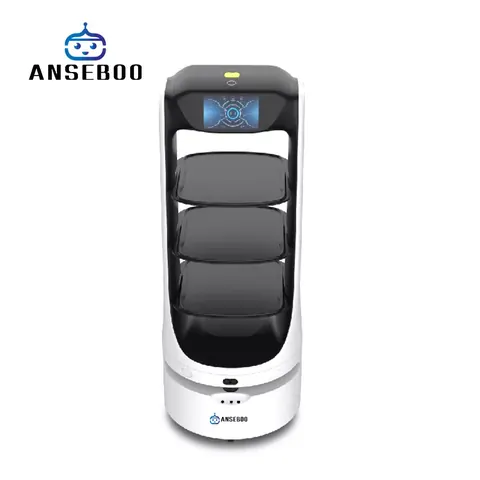
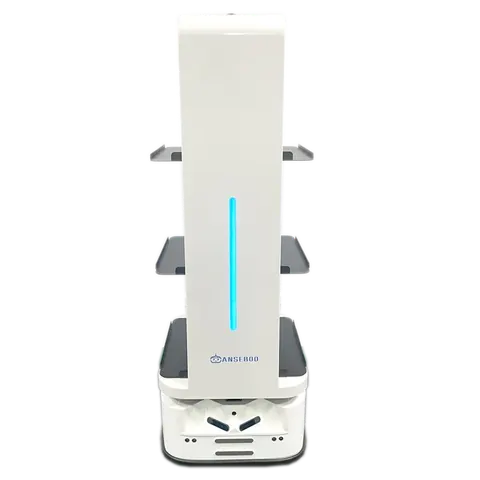
Capacity is the first price step because it changes the platform. CA01 takes three 320 × 400 mm trays; CA02 takes three 500 × 450 mm trays, which is a different frame and a different bill of materials. Four-tray models such as FD05 and FD09 add capacity again, at the cost of a wider footprint.
Payload limits follow the same logic: the FD series publishes 15 kg per trip while the AS10 carries 20 kg. If your heaviest tray is a stack of ceramic bowls, that difference is the difference between one trip and two.
3. Runtime and charging change the configuration
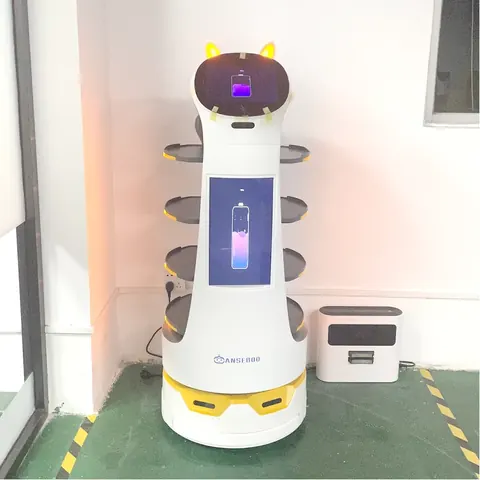
A 10-hour battery is not a 10-hour service: the robot moves, waits at tables, and returns to the dock. Two units rated at "about 10 hours" can behave very differently once you add a second service, so whether the model recharges itself or needs 2–4 hours on a manual charger is a real cost line, not a footnote.
Automatic docking usually appears as an option rather than in the base price. If your venue runs lunch and dinner back to back, price it in from the start instead of adding it later.
4. Navigation and cross-floor control are the expensive options
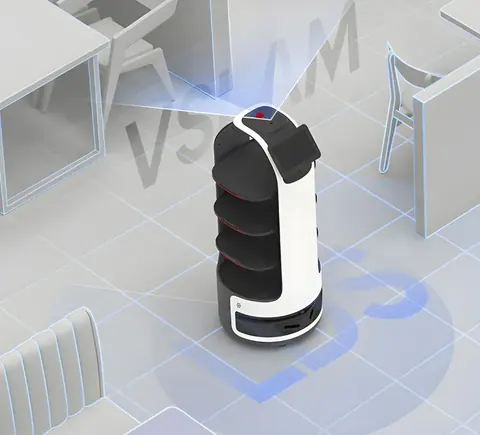
Single-floor laser navigation is now the baseline: CA01 and CA02 run 25 m laser navigation with autonomous obstacle avoidance and turn inside a 254 mm radius. Cross-floor operation is a different class of project — it needs elevator and door integration, per-building commissioning, and a fallback plan when the lift is busy.
Only some models in a range support it. In the delivery range that is the AS10, which publishes elevator and electric-door control. Pricing a cross-floor deployment as if it were a single-floor one is the most common budgeting error we see.
5. Integration depth: button, screen, POS or SDK
There are three common levels. A call button at the pass works on day one and costs nothing extra. The robot’s own screen removes the button but adds setup. A POS or API integration that queues tasks automatically saves the most staff steps, and is the level that needs your POS vendor to expose an interface — which is work, and is priced as work.
An open SDK / API keeps the third level available later even if you start with buttons. It is worth confirming in writing which interfaces a model exposes, because that decides whether the next integration is a configuration or a project.
6. How to compare two quotes on the same scope
Write the scope down before you read either quote: trays and their size, payload of the heaviest tray, runtime for one service, single or multi-floor, integration level, number of venues, training, spare parts, warranty length and response time, and who pays freight and duties.
Then map each line of both offers onto that list. The cheaper offer usually turns out to exclude one of: the docking station, the mapping and commissioning visit, the spare tray set, or the second-year service contract. That is the number you are actually comparing.
7. Budget the running cost, not just the robot
The robot is a capital item; the operation is a monthly one. Staff time saved per trip is the benefit, and it is real — but it is only realised if the robot is actually used during the rush, which comes back to tray count and runtime.
Build a simple model: trips per service, minutes per trip, and how many of those minutes move from a person to the robot. Then compare that with the total cost of ownership across the period you plan to keep the unit. A cheaper robot that needs a mid-service battery swap often costs more in staff time than the difference in purchase price.
Before you order
- Ask for the tray count and the exact tray dimensions, not just "three trays".
- Give the supplier the weight of your heaviest tray and confirm it against the published payload.
- Ask what the runtime means in one real service, and whether docking is included or optional.
- Confirm whether the model supports elevator and door control if you have more than one floor.
- Ask which integration levels exist: call button, screen, POS, SDK/API.
- Request the deployment scope in writing: mapping, docking layout, training, commissioning.
- Ask for spare parts pricing and the response time of the service contract.
- Confirm who pays freight, duties and local installation.
- Ask for a pilot or evaluation unit before committing to a fleet.
- Get both quotes on the same scope list — otherwise compare nothing.